Posts

DGUF Conference 2016 - Experiencing politics in Berlin

Image
I did not expect such a good weather in Berlin. With a full program from Thursday to Sunday, I had limited time to see Berlin, so right after checking in at the hotel I run out for a walk. I usually see politics everywhere, but Berlin was overwhelming; the struggle between Communism and Capitalism is still more than evident anywhere you look. Curry at the Wall, Berlin I wanted to open the post with this photo, because it is, in a way, a perfect introduction to my thoughts on the conference. You can only see the sausage and a bit of a balloon right where the wall was, not that long ago. Of course, Coca Cola is there and the bear holds victoriously his sausage as a trophy. Communism is over and we are all so happy about it that the new planning of the city embraced Capitalism in a way few cities have done.  Meanwhile, in Checkpoint Charlie, a couple of guys in army uniforms  take photos  with happy tourists that just entered the USA quarter. I cannot pay my publ...
Evaluating our journal

Image
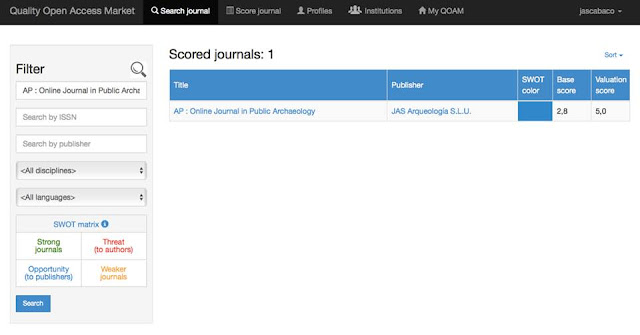
This year's   editorial   had a lot to do with the future of the archaeology publishing world – a future that looks bleak – and an Open Access model that should confront neoliberal trends in academic publishing. It might sound strange coming from a journal sponsored by a company, but we believe our ethical stand on this matter is crystal clear. One of the issues we need to address now is the quality of the journal. There are certain things we are not willing to change. For instance, we believe that a large academic Editorial Board, which has little or no involvement in the real daily affairs of the journal, would not change anything for the better. However, there clearly is room for improvement and we ask you to help us in this effort. Radboud University Nijmegen has launched " Quality Open Access Market " (QOAM) to evaluate Open Access journals in a collaborative way. We want to use this tool in order to improve the journal, so we will not ask y...

Editorial: Consolidating the model

As we are about to bid farewell to 2015, we must admit that this past year has been interesting regarding the academic publishing sector. In September 2014 we presented a poster at the EAA Meeting in Istanbul to celebrate our journal’s first five years. One of the points highlighted in our poster was our commitment to provide a completely free service to both authors and readers. This academic publishing model is by no means innovative. It has been established in Spanish archaeology since 1998 with ArqueoWeb and, during the past few years, most institutional journals have been uploaded under the OJS (Open Journal Systems) platform. In the case of public institutions, Open Access is understood as part of their academic responsibilities and its standard costs are incorporated in the general budget for publications. In our case, JAS Arqueología S.L.U. supports the small material costs of the journal, while our team works voluntarily for the project. Then, is AP Journal a loss-mak...

Review: Best Practices in World Heritage

Image
Review of the II International Conference on Best Practices in World Heritage: People and Communities (Mahón, April-May 2015) by Nekbet Corpas Cívicos Group photo of  the Conference  assistants  in the venue Some weeks after the 2nd International Conference on Best Practices in World Heritage , it is time to take stock. This second edition, which focused on People and Communities, would not have been possible without substantial development in research and continuous effort. Excitement and accumulated experience were essential for the Complutense University of Madrid’s research team of which the Conference’s directors, Alicia Castillo and Ángeles Querol, are part. Once again, Menorca’s Council supported the event in its search for support to the Talayotic Menorca’s nomination to UNESCO World Heritage. The topic of this second edition, held in Mahon (Menorca, Balearic Islands) from the 29th of March to the 2nd of April 2015, perfectly ref...

DGUF Conference 2015 - Is the public creating a different archaeology? Analyses of a power shift. (Tübingen, 14-17th May)

Image
By Chiara Zuanni (University of Manchester) Last month I had the opportunity to participate in the annual conference of the DGUF (Deutsche Gesellschaft für Ur- und Frühgeschichte e.V. – German Association for Pre- and Protohistory). This year’s theme focused on public archaeology and aimed to explore the possibilities and consequences of public involvement with the past. During the two days which comprised the academic programme, many different aspects of community archaeology, citizen science, and archaeological communication projects were explored. On Friday, Sylvia Crumbach unpacked the relationship between re-enactment groups and textile archaeologists: she argued that while both develop a great expertise in ancient clothing, it remains to be understood how museum reconstruction and images affect re-enactment costumes, and vice versa. The controversies raised by public approaches to archaeological work were highlighted in the afternoon, by two papers discussing metal detec...

Giveaway alert!

Image
To celebrate 1 year since publishing our first Special Volume, we will draw one lucky winner who will receive paper versions of Vol. 4 and Special Volume 1.  Wherever you live in the world, participate by simply liking and sharing the post on our Facebook page until Sunday, 14 June!  Good luck!

Seminari a l’entorn dels valors del patrimoni i l’interacció amb el públic en l’arqueologia [Seminar on heritage values and public interaction in archaeology]

Image
Within the framework of a workshop for the “ Heritage Values ” project, the GAPP (Heritage and PublicArchaeology Group) at University of Barcelona organized an intense seminar about public interaction in archaeology. Intense, because we had the opportunity to share and debate projects and ideas with nearly 20 colleagues in one day, which started for me at 5 am to take the train from Madrid to Barcelona. The seminar consisted of three parts: sustainability and participation in heritage policy; cultural tourism and new technologies; and the role of public archaeology as a participation tool. The outcomes of the seminar will be published soon, so I will not make a traditional review of the different papers presented, but rather a general comment on the topics debated and will share some thoughts about them. Image: Seminar poster and programme (source: Universitat de Barcelona ) How do we interact with the public as professionals? How does the public interact with arc...